
How to Select a Turbocharger for an Industrial Diesel Engine

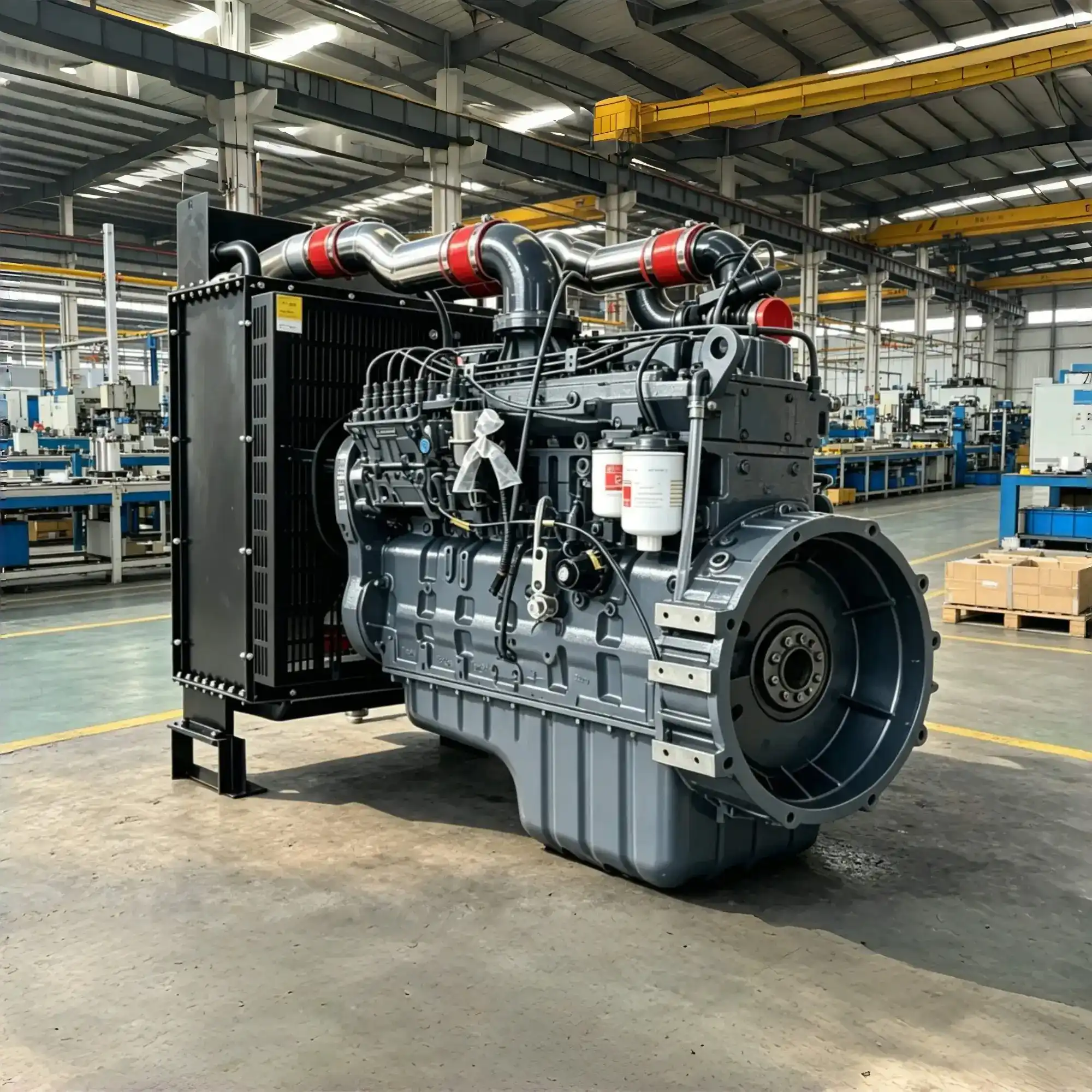
Diesel engine turbocharger selection starts by matching the engine’s required airflow and boost pressure to a compressor map, then checking turbine performance, exhaust temperature, shaft speed, and installation compatibility. The correct turbocharger must support the engine’s rated power and torque across its operating range without entering compressor surge, exceeding flow limits, or creating excessive exhaust backpressure. For industrial engines, the final choice must also match the manufacturer’s fuel calibration, emissions configuration, and duty cycle.
A turbocharger that works well on a highway engine may perform poorly on an excavator or constant-speed generator. These applications place different demands on low-speed torque, transient response, and sustained thermal loading. Selecting by compressor wheel diameter or advertised horsepower alone overlooks those differences.
What Determines the Right Turbocharger Size?
A turbocharger uses exhaust energy to drive a turbine connected to an intake-air compressor. The compressor increases intake pressure, allowing the engine to receive more air for combustion.
Its ability to support engine output depends on the amount of air it can deliver, the required pressure ratio, compressor efficiency, and the energy available from the exhaust.
For an industrial diesel engine, start with the following specifications:
| Selection Parameter | Why It Matters |
|---|---|
| Engine displacement | Helps establish the engine’s air consumption |
| Rated power and RPM | Identifies high-load operating requirements |
| Torque curve | Shows the low- and mid-speed operating demands |
| Required air mass flow | Determines compressor flow capability |
| Compressor pressure ratio | Defines the compression required at each operating point |
| Exhaust temperature and flow | Influence turbine matching and thermal limits |
| Operating altitude | Affects inlet pressure and compressor operating conditions |
| Charge-air cooling | Affects manifold temperature and pressure losses |
| Engine duty cycle | Determines sustained loading and transient response requirements |
The most reliable starting point for replacement applications is the engine serial number and original turbocharger part number. The original engine calibration and hardware specification determine whether an alternative turbocharger is acceptable.
How to Read a Turbocharger Compressor Map
A compressor map shows how a compressor performs at different corrected airflow rates and pressure ratios.
It also identifies regions of stable operation, efficiency contours, and shaft-speed limits. These characteristics help engineers determine whether the turbocharger can serve the engine across its operating range.
Airflow and Pressure Ratio
The horizontal axis normally shows corrected mass airflow. The vertical axis shows compressor pressure ratio.
Corrected airflow accounts for inlet temperature and pressure according to the map manufacturer’s reference conditions. Therefore, actual airflow should not be plotted against a corrected-flow axis without the required conversion.
Compressor pressure ratio is calculated as:
Pressure Ratio = Compressor Outlet Absolute Pressure / Compressor Inlet Absolute Pressure
For a simplified example, assume:
- Atmospheric pressure: 100 kPa absolute.
- Compressor inlet pressure: 98 kPa absolute.
- Compressor outlet pressure: 200 kPa absolute.
The pressure ratio is:
PR = 200 / 98 ≈ 2.04
This result describes a compressor operating point. It does not establish a suitable turbocharger size without the corresponding airflow requirement.
Engine manifold pressure may differ from compressor outlet pressure because the charge-air cooler and piping introduce pressure losses.
Surge and Choke Limits
The surge line marks a region where compressor airflow can become unstable. Operation near or beyond that boundary may cause pressure oscillations, noise, and additional mechanical stress.
At the opposite side of the map, the choke region represents the compressor’s high-flow boundary. Efficiency generally decreases as the compressor approaches its flow limit.
For reliable matching, engineers should plot several engine operating points rather than only the maximum horsepower condition.
Low-speed, high-torque operation may approach the surge boundary, while rated-speed operation may approach the choke boundary. Both conditions matter in industrial equipment.
Efficiency Islands and Turbocharger Speed
Efficiency contours show how effectively the compressor converts shaft power into increased air pressure.
Higher compressor efficiency generally reduces the temperature rise associated with compression at a given pressure ratio.
However, the best operating point is not necessarily the center of the highest efficiency island. The full operating range, acceptable response, and turbocharger speed limits must also be considered.
Garrett’s compressor-map guidance explains surge, choke, corrected flow, pressure ratio, efficiency islands, and shaft-speed lines in more detail.
Choosing the Turbine: Response vs Exhaust Backpressure
Compressor selection is only half of turbocharger matching. The turbine must provide sufficient power to drive the compressor while maintaining acceptable exhaust pressure and temperature.
One important design parameter is the turbine housing area-to-radius ratio, commonly called A/R.
Small vs Large Turbine Housing A/R
A smaller turbine housing A/R can improve response at lower engine speeds by increasing the energy available to drive the turbine.
However, an excessively restrictive turbine housing may increase exhaust backpressure at higher engine loads.
A larger A/R can reduce turbine restriction under some operating conditions but may produce slower boost response.
| Characteristic | Smaller Turbine A/R | Larger Turbine A/R |
|---|---|---|
| Low-speed response | Often quicker | May be slower |
| High-load exhaust restriction | May be higher | May be lower |
| Transient performance | Can favor faster boost response | Depends on available exhaust energy |
| Industrial suitability | Depends on the engine torque curve | Depends on sustained airflow and load requirements |
These are general tendencies, not guarantees. Turbine wheel geometry, engine exhaust flow, wastegate operation, and variable-geometry control can significantly change the result.
Wastegate and Variable-Geometry Considerations
A wastegate regulates turbine power by diverting some exhaust flow around the turbine under specified operating conditions.
Variable-geometry turbochargers adjust turbine flow characteristics to meet different speed and load requirements.
Both approaches require compatible controls and calibration. Replacing a fixed-geometry turbocharger with a variable-geometry unit is not a simple mechanical substitution.
Before changing turbine technology, confirm the engine’s approved configuration, actuator requirements, ECM compatibility, and emissions obligations.
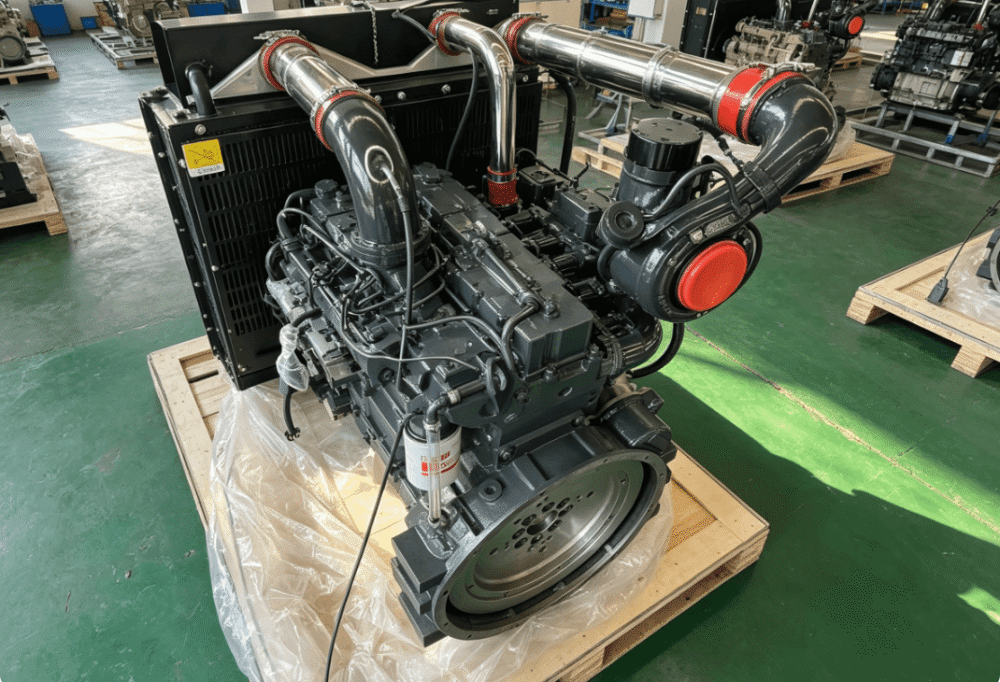
How to Match a Turbocharger to Industrial Engine Applications
The correct operating range changes with the driven equipment. A turbocharger should match where the engine spends its working hours, not merely the highest speed it can reach.
Construction Machinery and Variable Loads
Excavators, wheel loaders, and hydraulic machinery frequently experience rapid changes in engine load.
Good low-speed response is important when hydraulic demand increases suddenly. However, the turbocharger must also deliver sufficient airflow during sustained heavy digging or lifting.
Kangjin Power’s Cummins QSB4.5 diesel engine is offered in several industrial configurations, including ratings from 82 to 119 kW on its product page.
For a compact construction machine using this engine family, the turbocharger must match the specific engine rating and ECM calibration. Another QSB4.5 configuration may not use interchangeable turbocharger hardware.
Higher-Torque Industrial Equipment
Industrial engines with greater displacement can require substantially different compressor flow and turbine characteristics.
For example, the Cummins QSB6.7 diesel engine includes several turbocharged and aftercooled configurations with different power and torque ratings.
When comparing turbocharger options, the engine’s rated-speed operating point and torque-peak region both require attention.
A turbocharger selected only for maximum airflow may respond poorly when the equipment operates at lower engine speeds.
Continuous-Duty Pumps and Generator Drives
Stationary pump drives and generator engines often operate for extended periods near a defined speed.
For these applications, sustained thermal performance and turbine efficiency can be more important than rapid acceleration response.
The Cummins 6CTA8.3 diesel engine is a turbocharged and aftercooled platform used in industrial pumps, machinery, and generator applications.
Its engine-specific turbine, compressor, and fueling configuration should be evaluated at the intended continuous operating point.
For heavy-duty machinery using the Cummins QSM11 diesel engine, prolonged high-load operation makes charge-air cooling, exhaust temperature, and turbine backpressure important matching considerations.
High-Altitude Industrial Installations
Altitude reduces atmospheric pressure and changes the compressor pressure ratio needed to achieve a particular manifold pressure.
At higher elevations, a turbocharger may need greater pressure ratio and shaft speed to compensate for thinner incoming air.
However, turbochargers have compressor-speed and temperature limits. Some engines therefore require altitude-related power reduction.
Kangjin Power’s diesel engine altitude derating guide explains why turbocharged engines can still lose available power in mountainous operating conditions.
Any proposed turbocharger replacement for high-altitude service must be checked against the manufacturer’s approved engine rating and turbocharger operating envelope.
Installation Compatibility and Common Selection Mistakes
A turbocharger with an acceptable compressor map may still be unsuitable for the engine.
Mechanical interfaces, lubrication, cooling, electronic controls, and exhaust connections must also match.
Check Installation Interfaces
Before approving an alternative turbocharger, verify:
- Engine serial number and original turbocharger part number.
- Exhaust manifold flange and turbine housing orientation.
- Compressor inlet and outlet diameters.
- Oil supply and drain connections.
- Coolant connections, where fitted.
- Wastegate or actuator specifications.
- Charge-air cooler and hose compatibility.
- Exhaust outlet and aftertreatment connections.
- Engine control and emissions calibration.
Oil drainage deserves particular attention. Incorrect drain orientation or excessive crankcase pressure can cause oil leakage even when the turbocharger itself is functional.
Do Not Use Boost Pressure as the Only Selection Criterion
Two turbochargers can produce similar manifold boost pressure while operating at different compressor efficiencies, shaft speeds, and airflow rates.
Likewise, a high boost reading does not establish that the engine receives the intended air mass if intake temperature is excessive.
Check the complete intake and exhaust system before concluding that the turbocharger is undersized.
Kangjin Power’s diesel engine air intake restriction test guide explains how inlet restrictions can affect available air and turbocharger operating conditions.
Check Exhaust Temperature and Engine Protection Limits
Changing the turbine or compressor can alter exhaust pressure, charge-air temperature, combustion conditions, and transient response.
Excessively high exhaust temperature may indicate overloading, insufficient air, unsuitable fueling, or other system problems.
The diesel engine exhaust gas temperature monitoring guide explains why EGT must be interpreted by sensor location and operating conditions.
A replacement turbocharger should never rely on unapproved fueling changes to achieve its advertised performance.
Comparing Original and Alternative Turbochargers
For a replacement project, the original engine-approved part is usually the safest baseline.
If a different turbocharger is being considered, request technical documentation showing compatibility with the specific engine configuration.
| Evaluation Item | Required Evidence |
|---|---|
| Compressor matching | Map and operating points across the engine speed range |
| Turbine matching | Flow, backpressure, temperature, and response evaluation |
| Mechanical fitment | Dimensions, flange details, and connection drawings |
| Thermal durability | Approved temperature and shaft-speed limits |
| Control compatibility | Wastegate or actuator and calibration information |
| Engine application | Model, serial number, rating, and emissions configuration |
Do not assume that two turbochargers are interchangeable because their mounting flanges fit or their compressor wheels have similar dimensions.
For regulated engines, an unapproved turbocharger change may also affect emissions compliance, warranty coverage, and engine durability.
Conclusion
Diesel engine turbocharger selection requires matching compressor airflow, pressure ratio, turbine performance, and engine operating conditions.
For industrial equipment, the most suitable turbocharger delivers adequate air across the required speed and load range without excessive backpressure, compressor instability, or thermal stress.
When replacing an existing unit, begin with the engine serial number and original turbocharger specification. Any alternative should have documented performance, installation, and calibration compatibility.
Frequently Asked Questions
How do you select the correct turbocharger for a diesel engine?
Start with engine displacement, rated power, torque curve, operating speed, and required airflow. Then evaluate compressor pressure ratio, surge and choke limits, turbine performance, and installation compatibility. Manufacturer-approved specifications should guide replacement decisions.
Does a bigger turbocharger always increase diesel engine power?
No. A larger turbocharger may provide additional flow capability but can also reduce low-speed response. Engine fueling, compressor efficiency, turbine matching, cooling capacity, and calibration determine whether additional performance is possible.
What is a compressor map used for in turbocharger selection?
A compressor map shows corrected airflow, pressure ratio, efficiency, and operating limits. Engineers use it to check whether the engine’s expected operating points remain within the compressor’s usable range.
How does turbine A/R affect diesel engine performance?
A smaller turbine A/R can improve low-speed response but may increase exhaust restriction at higher loads. A larger A/R can improve high-flow capability in some configurations but may respond more slowly.
Can a turbocharger from another engine model be installed?
Only after confirming performance, mechanical fitment, lubrication, cooling, control compatibility, and any emissions requirements. Matching exhaust flanges or compressor wheel sizes alone does not establish interchangeability.
Technical References
The following manufacturer resources provide additional guidance on turbocharger matching, compressor-map interpretation, and turbine selection.
- Garrett Motion – Turbocharger Selection Guide – Explains airflow, pressure ratio, and compressor matching.
- BorgWarner – Understanding Compressor Maps – Covers corrected mass flow, efficiency islands, surge, choke, and turbocharger speed.
- BorgWarner – MatchBot Turbo Matching Tool – Provides an engineering-based starting point for compressor and turbine matching.

