
6CTA8.3 vs 6CTAA8.3: Specs, Power & Applications


The 6CTA8.3 and 6CTAA8.3 are both 8.3-liter, six-cylinder Cummins diesel engines, but they are not simply two versions ranked by horsepower. Both use turbocharging, while documented 6CTA configurations already include aftercooling. The 6CTAA8.3 is also used in aftercooled configurations, particularly in commercial-industrial generator applications. Actual power, torque, dimensions, and equipment compatibility depend on the specific engine model and rating.
This makes the 6CTA8.3 vs 6CTAA8.3 comparison more useful when it is based on application and configuration rather than the model name alone. The same 8.3-liter engine family can be configured differently for generators, pumps, marine equipment, and other industrial machinery.
6CTA8.3 vs 6CTAA8.3: What Is the Difference?
Both engines belong to the Cummins C Series and use an inline six-cylinder, four-stroke diesel architecture.
The 8.3-liter platform uses a 114 mm bore and 135 mm stroke, producing approximately 8.3 liters of displacement. Actual specifications vary according to the engine configuration and application.
| Specification | 6CTA8.3 | 6CTAA8.3 |
|---|---|---|
| Engine family | Cummins C Series | Cummins C Series |
| Displacement | 8.3 L | 8.3 L |
| Cylinders | Inline 6 | Inline 6 |
| Bore × stroke | 114 × 135 mm | 114 × 135 mm |
| Aspiration | Turbocharged / aftercooled | Turbocharged / aftercooled |
| Fuel system | Configuration-dependent | Configuration-dependent |
| Main applications | Generators, pumps, marine, industrial equipment | Commercial-industrial generator sets |
| Power rating | Application-dependent | Application-dependent |
The common assumption that the 6CTA8.3 is simply a non-aftercooled version of the 6CTAA8.3 is therefore misleading.
Cummins documentation identifies the 6CTA8.3 as a turbocharged and aftercooled engine in its 6CT/6CTA8.3 product range.
The 6CTAA8.3 designation is used in Cummins commercial-industrial generator applications, where the published output depends on the generator configuration and operating conditions.
How Does Aftercooling Affect the 8.3-Liter Engine?
Aftercooling reduces the temperature of compressed intake air after it passes through the turbocharger.
A turbocharger increases intake-air pressure, but compression also increases air temperature. Cooling the compressed air increases its density before it enters the cylinders.
This helps the engine maintain the required air supply under higher load.
Key benefits include:
- Higher intake-air density.
- Better control of intake temperature.
- Support for higher power output.
- Improved thermal management during sustained operation.
Aftercooling alone does not determine engine horsepower.
Turbocharger specification, fuel delivery, injection timing, rated speed, and engine calibration also affect the final output.
This is why two 8.3-liter engines can have noticeably different ratings despite sharing the same basic architecture.
6CTA8.3 Power and Application Examples
The 6CTA8.3 has been produced for several applications, so there is no single horsepower figure that applies to every version.
Cummins lists commercial-industrial 6CTA8.3 generator applications with 128–170 kW prime power and 140–185 kW standby power, depending on configuration.
The same engine family has also been adapted for marine applications.
For example, Cummins lists marine 6CTA8.3-DM configurations with ratings around 219–270 BHP, depending on engine speed and configuration.
These differences demonstrate why engine ratings should always be connected to the intended application.
For pump systems, the engine needs to provide sufficient shaft power at the pump’s operating speed.
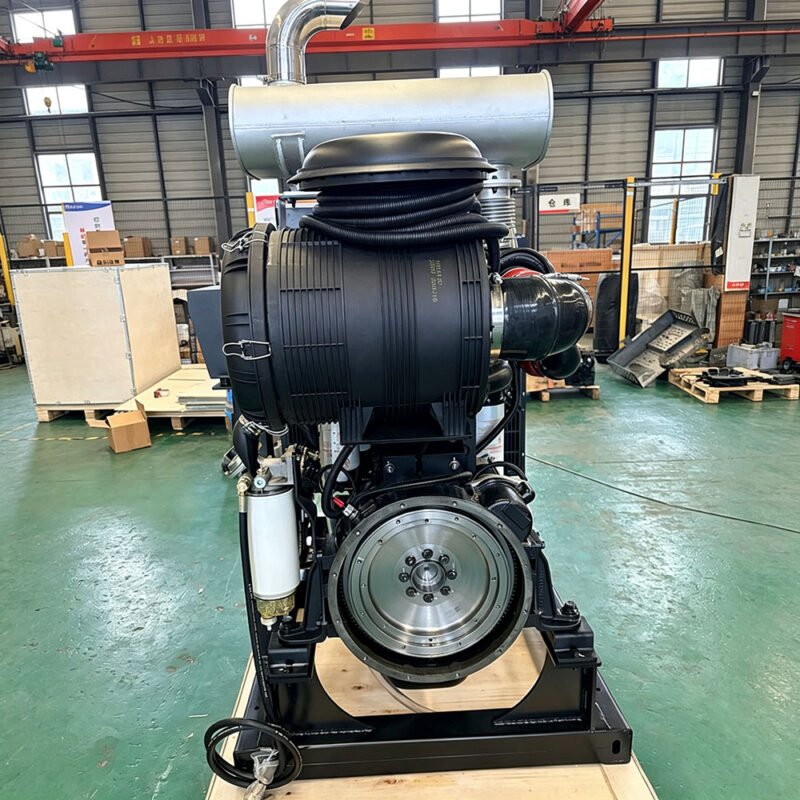
Kangjin Power’s Cummins 6CTA8.3 diesel engine provides a reference for this engine platform and its industrial applications.
What Are the 6CTA8.3 and 6CTAA8.3 Power Differences?
The 6CTAA8.3 is particularly associated with commercial-industrial generator sets.
Cummins lists 6CTAA8.3 generator sets with:
- 160–205 kW prime power.
- 176–225 kW standby power.
- 151 kW continuous power.
- 50 Hz and 60 Hz configurations.
These figures describe specific generator configurations rather than every 6CTAA8.3 engine ever produced.
Cummins’ 6CTA8.3 generator range is listed at 128–170 kW prime power.
This means the published 6CTAA8.3 generator range can be higher than the 6CTA8.3 generator range. However, it would be incorrect to conclude that every 6CTAA8.3 engine is more powerful than every 6CTA8.3.
The exact engine dataplate, CPL, serial number, and rating should be checked before making a direct comparison.
Dimensions and Weight: Are They the Same?
The basic engine architecture is similar, but complete dimensions and weight vary according to the application.
For a Cummins marine 6CTA8.3 configuration, published dimensions are approximately:
| Dimension | 6CTA8.3 Marine Configuration |
|---|---|
| Length | 1,182 mm |
| Width | 710 mm |
| Height | 1,137 mm |
| Weight | 702 kg / 1,545 lb |
These figures should not automatically be used for a generator or construction configuration.
A complete industrial installation can have different accessories, cooling systems, exhaust components, mounts, and flywheel arrangements.
When replacing an existing engine, check:
- Engine mounting positions.
- Flywheel housing.
- Crankshaft centerline.
- Overall height and width.
- Cooling connections.
- Exhaust outlet position.
- Charge-air piping.
- Accessory arrangement.
The same displacement does not guarantee physical interchangeability.
6CTA8.3 vs 6CTAA8.3 Applications
Industrial Generators
Both engine configurations can be found in generator-related applications, but the exact rating matters more than the engine family.
A generator engine must maintain a stable operating speed corresponding to the alternator frequency.
For a four-pole alternator, 50 Hz operation normally uses 1,500 rpm, while 60 Hz operation commonly uses 1,800 rpm.
The correct engine therefore depends on the complete generator package and its required duty cycle.
Water Pump Systems
Water pumps require an engine capable of supplying the required shaft power at the correct operating speed.
The actual requirement depends on flow rate, discharge head, pump efficiency, and operating conditions.
Kangjin Power’s 6CTA8.3-P175 pump engine is an example of a configuration intended for pump-drive applications.
This type of application-specific rating is more useful than selecting an engine based only on its maximum horsepower.
Marine Equipment
Cummins also produced marine versions of the 6CTA8.3.
Marine engines operate under different cooling, exhaust, corrosion-protection, and duty-cycle requirements.
A marine-rated 6CTA8.3 should therefore be compared with another marine configuration rather than directly with an industrial generator engine.
Where Is the 6CTAA8.3 Used?
The 6CTAA8.3 is strongly associated with commercial-industrial generator applications.
Cummins lists this engine for generator sets serving markets across multiple regions, including Africa, the Middle East, Asia Pacific, Europe, India, Latin America, and North America.
The published range includes both prime and standby ratings.
This distinction is important because prime and standby power describe different operating conditions.
A generator expected to operate regularly should be evaluated according to its appropriate prime rating rather than simply using the higher standby figure.
Which Engine Is Better for Your Application?
There is no universal winner between the 6CTA8.3 and 6CTAA8.3.
The appropriate engine depends on the equipment load, operating speed, duty cycle, cooling system, and installation requirements.
When comparing the two, consider:
| Selection Factor | Why It Matters |
|---|---|
| Rated power | Must meet the equipment load |
| Rated RPM | Must match the driven equipment |
| Torque characteristics | Important for variable loads |
| Cooling system | Affects radiator and charge-air requirements |
| Duty cycle | Prime, standby, and continuous ratings differ |
| Physical dimensions | Determines installation compatibility |
| Fuel system | Must match the specific engine configuration |
| Emissions specification | Varies by production year and market |
| Flywheel housing | Determines drivetrain compatibility |
| Serial number | Identifies the exact engine configuration |
For an existing machine, replacing a 6CTA8.3 with a 6CTAA8.3 should not be treated as a simple engine swap.
The mounting system, cooling package, intake and charge-air system, exhaust, fuel controls, flywheel housing, and rated speed should all be verified.
Are 6CTA8.3 and 6CTAA8.3 Parts Interchangeable?
Some components may be shared because both engines are based on the 8.3-liter C Series architecture.
However, complete interchangeability should never be assumed from the engine family alone.
Turbochargers, fuel pumps, injectors, manifolds, aftercoolers, accessory drives, and exhaust components can vary between engine configurations.
For replacement parts, the safest approach is to match the complete engine model, serial number, and CPL.
This is particularly important for older Cummins engines because similar model designations can cover different production configurations.

FAQ
What is the main difference between 6CTA8.3 and 6CTAA8.3?
Both are turbocharged and aftercooled configurations in documented applications. Their differences are primarily related to specific ratings, calibration, application, accessories, and supporting systems.
Is 6CTAA8.3 more powerful than 6CTA8.3?
It can be in specific generator configurations. Cummins lists 6CTAA8.3 generator sets at 160–205 kW prime, while its 6CTA8.3 generator range is 128–170 kW.
Does 6CTA8.3 have an aftercooler?
Yes. Cummins identifies the 6CTA8.3 as turbocharged and aftercooled in its 6CT/6CTA8.3 documentation.
Are 6CTA8.3 and 6CTAA8.3 the same engine?
They share the same 8.3-liter, six-cylinder C Series foundation, but their complete configurations can differ.
Which engine is better for a diesel generator?
The correct choice depends on required prime or standby output, operating frequency, rated speed, ambient conditions, and duty cycle.
Can a 6CTAA8.3 replace a 6CTA8.3?
It may be possible, but compatibility must be checked. Mounting, flywheel housing, cooling, charge-air piping, fuel system, exhaust, rated speed, and controls should all be verified.
Summary
The 6CTA8.3 vs 6CTAA8.3 comparison is more nuanced than simply comparing the letters in the model designation. Both engines are based on Cummins’ 8.3-liter inline six-cylinder C Series platform, and documented 6CTA8.3 configurations already use turbocharging and aftercooling.
The 6CTAA8.3 is particularly associated with commercial-industrial generator applications and can have higher published generator ratings than the 6CTA8.3 range.
However, individual engine specifications depend on the production configuration, application, rated speed, CPL, and calibration.
For equipment selection or engine replacement, the complete model, serial number, CPL, rated power, operating speed, cooling arrangement, and physical interfaces should be checked together. This provides a much more reliable basis for comparison than relying on the engine name alone.

