
Cummins Engine Applications in Construction: A Technical Guide


The construction industry operates on a foundation of reliability and power density. Whether it is a massive infrastructure project or a localized urban development, the mechanical heartbeat of the job site is often a diesel engine. Among global manufacturers, Cummins has established itself as a primary choice for Original Equipment Manufacturers (OEMs) and fleet managers.
Understanding why these engines are ubiquitous requires looking beyond brand recognition and into the engineering specificities that allow heavy machinery to perform under extreme duty cycles.

Why High-Torque Performance Matters in Construction
Construction equipment does not operate like a standard highway vehicle. Instead of maintaining steady speeds, machines like excavators and dozers face “transient loads”—sudden, massive increases in resistance.
Cummins engines for construction equipment are engineered with a specific torque curve that prioritizes “lug back” capability. This allows the engine to maintain productivity even when the hydraulic system demands maximum power. This performance is largely driven by advanced turbocharging—specifically Variable Geometry Turbochargers (VGT)—which optimizes airflow across the entire RPM range.
Key Applications of Cummins Engines in the Field
The versatility of the Cummins lineup, ranging from the compact F-series to the high-horsepower QSX15, allows it to integrate into various machine types.
Earthmoving Equipment (Excavators and Dozers)
In excavators, the engine must balance fuel efficiency with hydraulic flow requirements. Models like the Cummins QSB6.7 and QSL9 are industry standards here. These engines provide the high-pressure common rail (HPCR) fuel systems necessary for cleaner combustion and faster response times when the operator engages the boom or bucket.
Lifting and Material Handling (Cranes and Telehandlers)
Cranes require precision and stability. The power delivery must be smooth to avoid jerky movements that could compromise safety. Cummins engines are favored in mobile and crawler cranes because of their integrated electronic control modules (ECMs), which allow the engine to communicate seamlessly with the crane’s load-sensing hydraulics.
Road Construction (Rollers and Pavers)
Paving equipment operates in high-heat, high-dust environments. Engines like the QSF3.8 offer a compact footprint for smaller rollers while maintaining the thermal management capabilities required to run continuously in ambient temperatures exceeding 40°C.
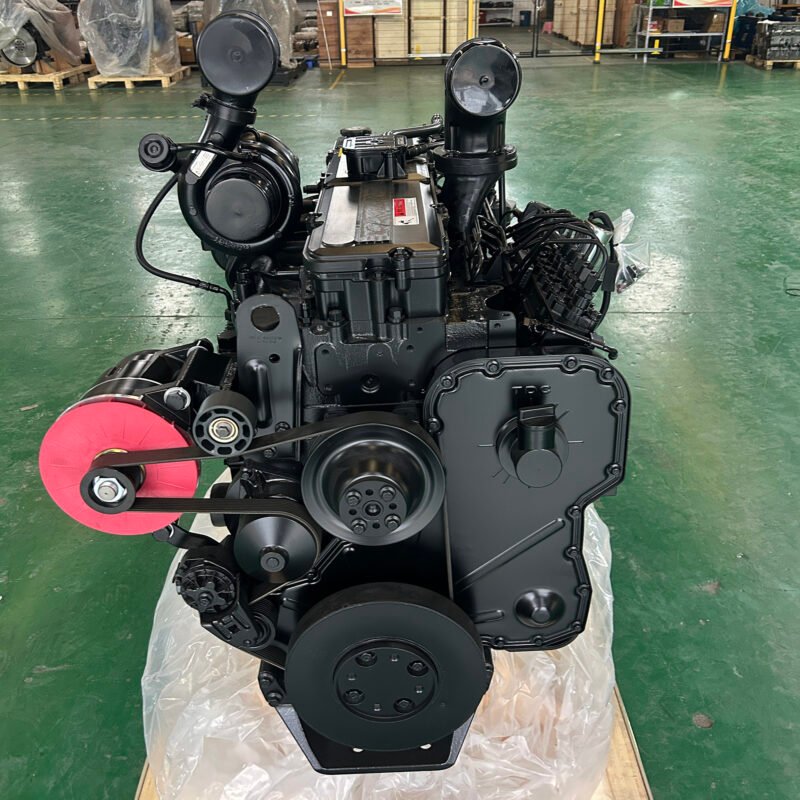
Technical Comparison of Common Construction Engine Series
| Engine Series | Displacement | Power Range (hp) | Primary Application | Key Technical Feature |
| QSB Series | 3.3L – 6.7L | 74 – 310 | Excavators, Forklifts | Robust HPCR Fuel System |
| QSL Series | 8.9L | 230 – 400 | Wheel Loaders, Drill Rigs | High Power-to-Weight Ratio |
| QSX Series | 15L | 400 – 675 | Large Dozers, Dump Trucks | Dual Overhead Cam (DOHC) |
Engineering for Harsh Environments: The Cummins Advantage
The construction site is an unforgiving environment characterized by abrasive dust, varying fuel quality, and extreme vibration. Cummins addresses these challenges through several engineering strategies:
Advanced Filtration: Construction-grade engines utilize multi-stage fuel filtration to protect injectors from contaminants common in bulk-stored site fuel.
Cooling System Integration: Many units, such as those found in the Kangjin Power construction machinery catalog, are designed with heavy-duty cooling packages to prevent derating during peak summer operations.
Modular Aftertreatment: To meet Tier 4 Final and Stage V emission standards, Cummins uses “Single Module” aftertreatment systems that are up to 40% lighter and 60% smaller than previous generations, easing the service burden for site technicians.
Navigating Emission Standards (Stage V and Tier 4 Final)
For modern construction projects, compliance is a prerequisite for bidding. Cummins has transitioned its construction lineup to meet Global Stage V standards, focusing on the reduction of Particulate Matter (PM) and Nitrogen Oxides (NOx).
What makes this relevant for operators is the “EGR-free” design found in many newer QSB and QSL models. By removing the Exhaust Gas Recirculation (EGR) component, the engine produces less heat and requires less maintenance, directly increasing the machine’s “up-time”—the most critical metric in construction profitability.
Integration and OEM Customization
One reason Cummins remains a dominant force is its adaptability for OEMs. Engineers can choose from various oil pan shapes (to allow for steep-angle operation on slopes), fan drive locations, and PTO (Power Take-Off) options. This modularity ensures that the engine does not just fit into the machine, but is optimized for the machine’s specific work tool, whether it’s a hydraulic breaker or a high-capacity pump.
For project managers and procurement specialists evaluating replacement engines or new fleet additions, the focus should remain on matching the engine’s duty cycle to the application. High-idle applications require different configurations than those intended for constant high-load crushing or milling.
FAQ
Q1: What is the average lifespan of a Cummins engine in construction?
A typical heavy-duty Cummins engine (like the QSL9) can reach 10,000 to 15,000 hours before a major overhaul, provided that scheduled maintenance (oil analysis, filter changes) is strictly followed.
Q2: Can Cummins construction engines run on B20 Biodiesel?
Most modern Cummins engines for construction are compatible with B20 biodiesel blends. However, this often requires more frequent fuel filter intervals and monitoring for moisture accumulation in the fuel system.
Q3: Why are QSB engines so common in mid-sized excavators?
The QSB series (3.3, 4.5, and 6.7) offers a balance of electronic sophistication and mechanical durability. Its ability to provide maximum torque at low RPM (revolutions per minute) reduces fuel consumption and noise on the job site.
Q4: What is the difference between a “Mechanical” and “Electronic” Cummins engine for construction?
Older mechanical engines (like the 6BT) rely on physical governors and are easier to repair in remote areas. Modern electronic engines (QS series) use ECMs to optimize fuel injection, meeting strict emission laws and providing diagnostic data that helps prevent catastrophic failure.
Reference Sources
Cummins Inc. Technical Documentation: Performance Curves for Off-Highway Engines.
Association of Equipment Manufacturers (AEM): Industry Standards for Tier 4 Final and Stage V Compliance.
ISO 8178: Standard for exhaust emission measurement for non-road internal combustion engines.
DieselNet: Technical summaries of emission standards for heavy-duty off-road engines.

